| | Episode #12 The VoiceAISpace Newsletter | |
| | | 3 × News
2 × Products
1 × Founder Spotlight
Space Updates | |
|
|---|
| | This week we are speaking about voice AI making service public more accessible, disrupting war and being slightly dodgy.
We will also check out two cool products, a voice AI benchmark directory and a hardware product combining voice technology and sleek design.
You'll also meet Haithem Kchaou from Callab AI (YC26), who joined the BotCast, and to close this edition you'll get a few updates about the VoiceAISpace.com platform. | |
03 | News The Good, The Bad & The Funky |
| | Mountain View lets residents follow City Council in 60+ languagesMountain View is piloting Wordly so people can follow public meetings in more than 60 languages via live audio and text on their phones. It debuted at planning commission, ran at City Council on 8 Sep, and covers Rental Housing Committee sessions too.
Why we like it:
A pure example of how implementing voice AI can improve accessibility in public services. Also having a public service adopting is a really good signal.
| |
| | Houthis accused of cloning a Yemeni general's voice to push a retreatDuring the fight for Mocha (a key Yemeni port town on the Red Sea), audio that sounded like a Yemeni military commander Lt General Tareq Saleh circulated with a withdrawal order. National Resistance Forces say Iran-backed Houthis used an AI clone to confuse troops. Saleh's office called the clip fake and told units to trust only official channels. (Independent verification is still pending).
Why it's bad:
Voice cloning does real good in medicine, giving people who lost their voice a way to speak again. We already know it fuels scams. Now it's on the battlefield, turning a commander's own voice against his troops. This is exactly why deepfakes are a serious concern.
| |
| | OnlyFans promoters on X may be using AI voice notes to pass as humanA developer ran bot tests on flirty X accounts funneling people to OnlyFans and shared the results with Malwarebytes. Every account opened with the same script. Then things got weird. One replied "Pineapple" to an instruction hidden in hex code. Another was asked for a 12-character reply, came back with 11, and caught its own mistake. They also sent voice notes reading out a Unix timestamp and a username on request. Nobody knows what model runs the show, and a human might be behind the curtain. Still, a voice note proves nothing anymore.
Why it's funky:
Is this the beginning of something? We are looking at the first glimpse of the cyber sexy companion we have seen in so many science fiction movies.
| |
Products Voice AI putting in the work | 02 |
| |  | #1 |
| |
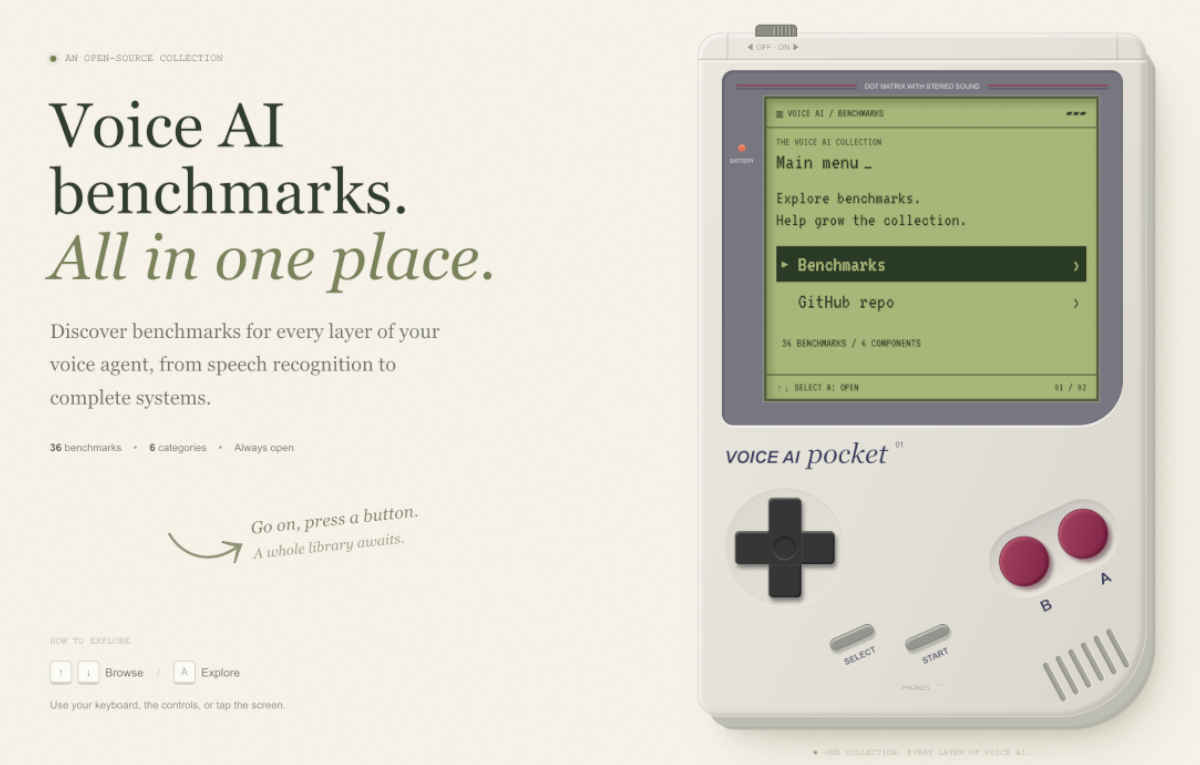
| | Voice AI Benchmarks is an open-source directory of speech, language, turn-taking, and full voice-agent evaluations. 36 benchmarks across six layers (STT, TTS, turn-taking, LLM, speech-to-speech, voice agents), each linking out to the benchmark (and often code or a paper). Why we picked it: we met Gonzalo at one of our meetups in Barcelona. He was already shipping cool stuff. It is nice to see him back on track with something that is not only useful but also designed with taste. | |
| |  | #2 |
| |
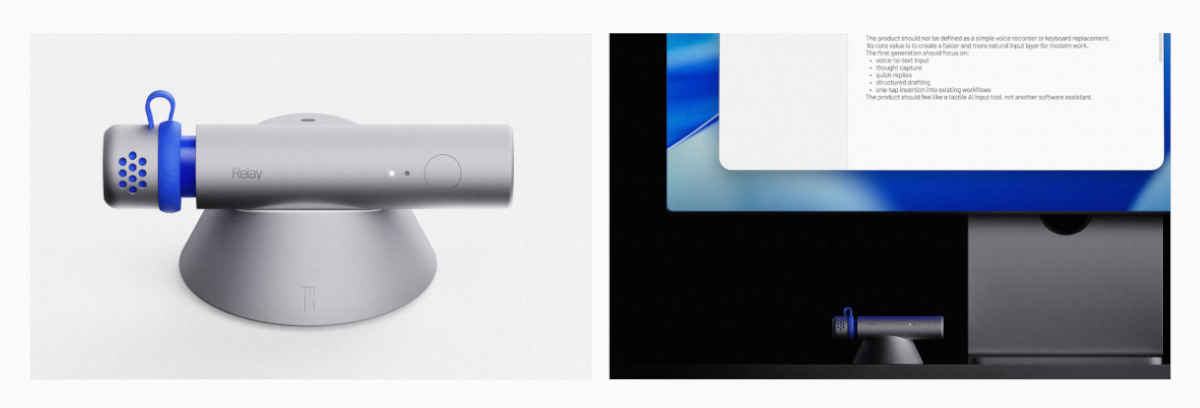
| | Relay is a macOS voice interface from London startup Relay Voice Ltd, founded by ex-Nothing duo Cookie Xu and Raymond Zhu. Hold a hotkey, speak into any text field, and Relay rewrites your words for the app, recipient, language and tone, or triggers a Skill. Push-to-talk only, no wake word. The optional Relay Q mic is built for close-range use, and Relay says it picks up a whisper. App is live now (14-day trial, then $15/month). Relay Q preorders are a $150 bundle with 12 months of Unlimited, shipping January 2027 according to Relay. Why we picked it: we have all seen the gooseneck mic around the internet. This has an awesome variation, with a slick design, a perfect combination of voice tech and hardware. We cannot wait to get our hands on it. | |
01 | Founder Spotlight Haithem Kchaou, Co-founder @ Callab AI BotCast Ep 8 |
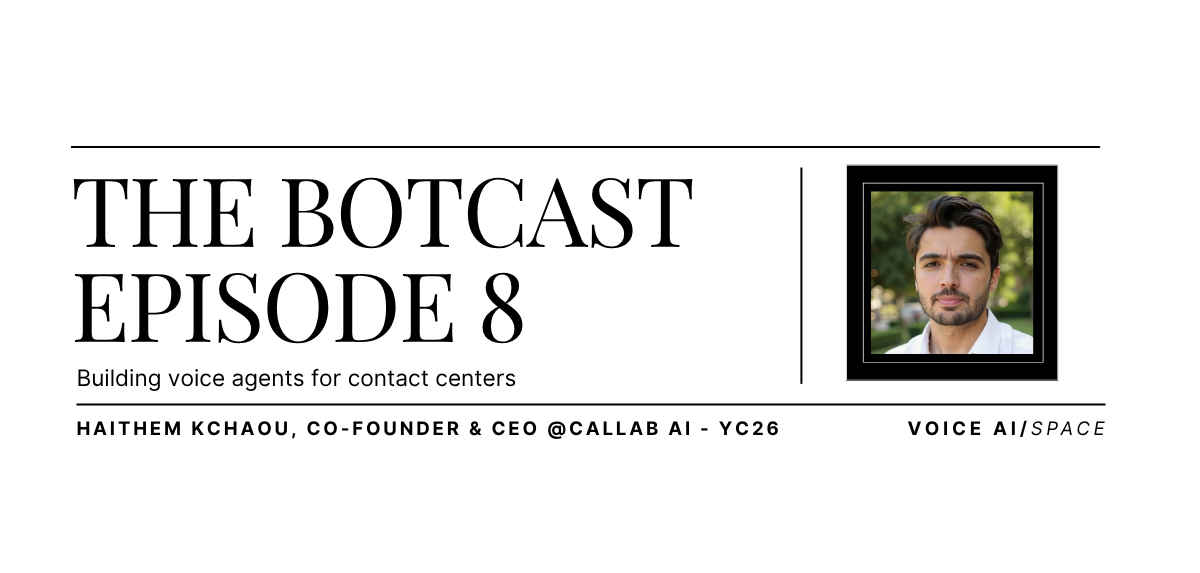 |
| | Source: BotCast #8, Voice AI Space. Who are you?Hi, I'm Haithem, co-founder of Callab AI. We build AI voice agents for contact centers, and what differentiates us is the fact that we've built the telephony layer ourselves. So we're more adapted to legacy phone infrastructure when it comes to old PBXs, for those who know what that is. It is like the old telephony systems that have been around before the modern ones, which are cloud-based. What we've noticed is that over 50% of the industry is still legacy, and the current voice AI solutions are not adapted for this market. That is the gap that we're bridging. How did you end up using voice AI?It is a funny story actually. Before this product, we were building a book app product, generating book summaries and audiobook summaries. We were trying to do the summaries with AI way before LLMs, so it has been quite a journey, and it didn't work, so it was really hard. We were also trying to do the speech part with AI, and that is how we noticed the progress of voice AI since about six years ago. At some point, we understood with LLMs that we needed to do something in the voice AI space, and I am personally coming from a country of call centers, so everything converged in building Callab AI. A moment of joy and pain using voice tech.We have had a lot of pain actually, and the first one is going to production. Everyone in the industry knows that it is quite easy to build prototypes and have a voice agent that works well in demos, but going to market brings different requirements and needs, especially when it comes to the mismatch between the current AI infrastructure and platforms and what is out there in the market. We had to build the telephony layer ourselves, especially in markets like the Middle East where we started initially. There is no CPaaS, like Twilio and Vonage, which are solutions that bridge between the telephony layer and the cloud and internet to provide cloud numbers. In our case, we had to integrate directly with local infrastructure, and that has been the most painful part of building the product. It took us more time than it took to build the AI part. And then, of course, the happy part is when you see it working. The fact that we built the infrastructure ourselves allowed us to do optimizations that gave us way better latency and much more granular control on turn-taking, which is why we now have a really good product compared to what is out there in the market. What lesson would you share with other builders?I thought a lot about this question, especially in the era of AI where having a moat is becoming harder and harder. Especially now with coding agents, having code is not defensible anymore. The strategy for us is to actually pick the path of hard resistance. In our case, it was building the infrastructure for telephony to be able to bridge the gap and integrate with legacy telephony. That is actually what got us into YC, the fact that we picked the path of hard resistance. I think in this era, that is the way to go for any startup to be able to have some sort of a defensible moat. That would be my main piece of advice for founders. Where do you see the industry in 12 months and in 5 years?For the next 12 months, what we are noticing is that the market has been educating itself for the past two years, and we see the trend accelerating in the next 12 months. We have been attending events, and the BPO leaders and contact center leaders are asking the right questions around AI. Now they know what AI can do and what AI cannot do, because there is still a long way to go to improve AI capabilities. That actually accelerates adoption, and that is what we are seeing now. When it comes to the five-year vision, it will become absurd for people to wait more than 30 seconds to get an answer or an inquiry from any business in the world. That implies that we won't have to type numbers like one, two, three in IVRs to be rerouted between call centers. That will become the norm, which means that voice AI will become the norm for contact centers in general. That is definitely where the industry is heading. Read / watch → BotCast #8: Haithem Kchaou | |
| | We are 1 away from having an incredible 900 products in our library!
We've received some amazing submissions last week and have many other products we've discovered and want to add. But we are taking a small break as we carefully select a special one for you.
We'll be updating the library over the next week. We will keep you updated. 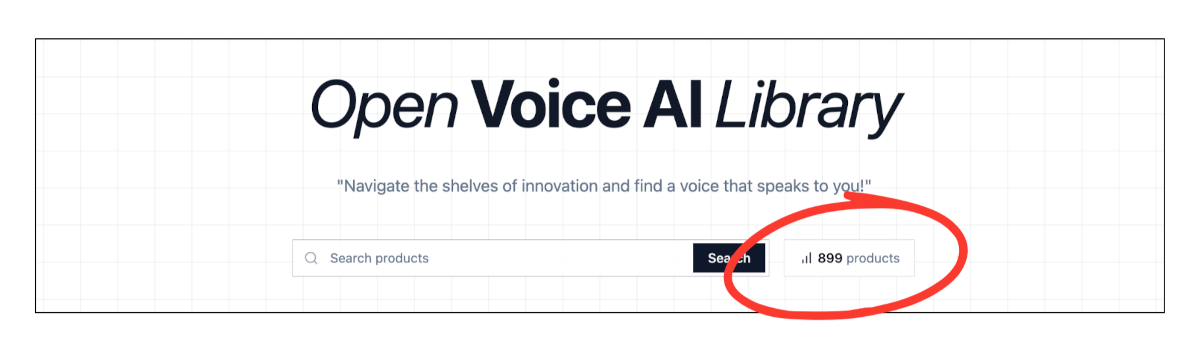 | |
| | The revamped job board is really successful…
Over 10000 human clicked on various pages over the last 30 days and millions of bots have scrapped it … 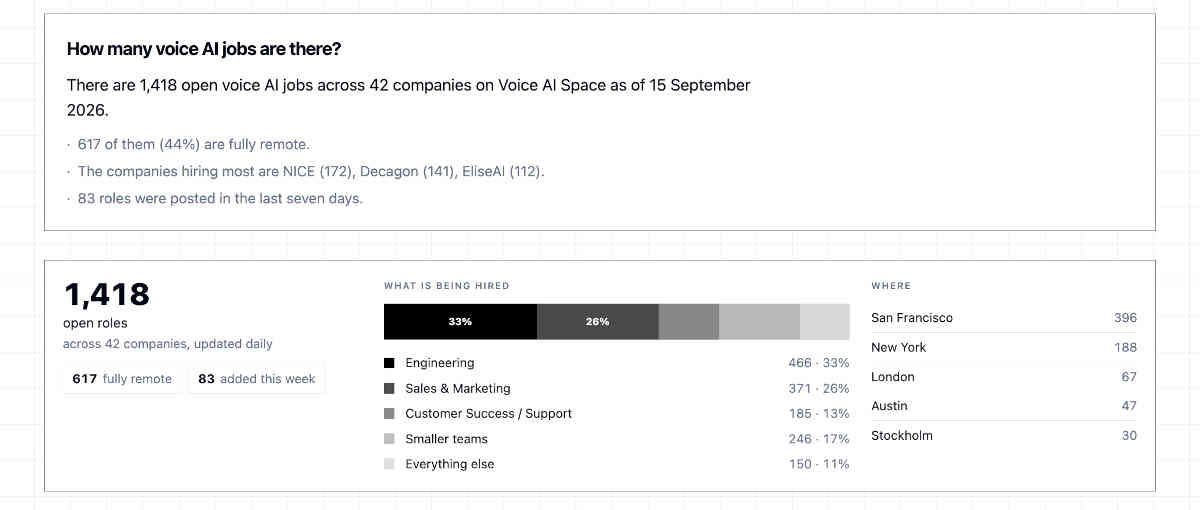 | |
| | You can now find all the BotCast episodes in one place 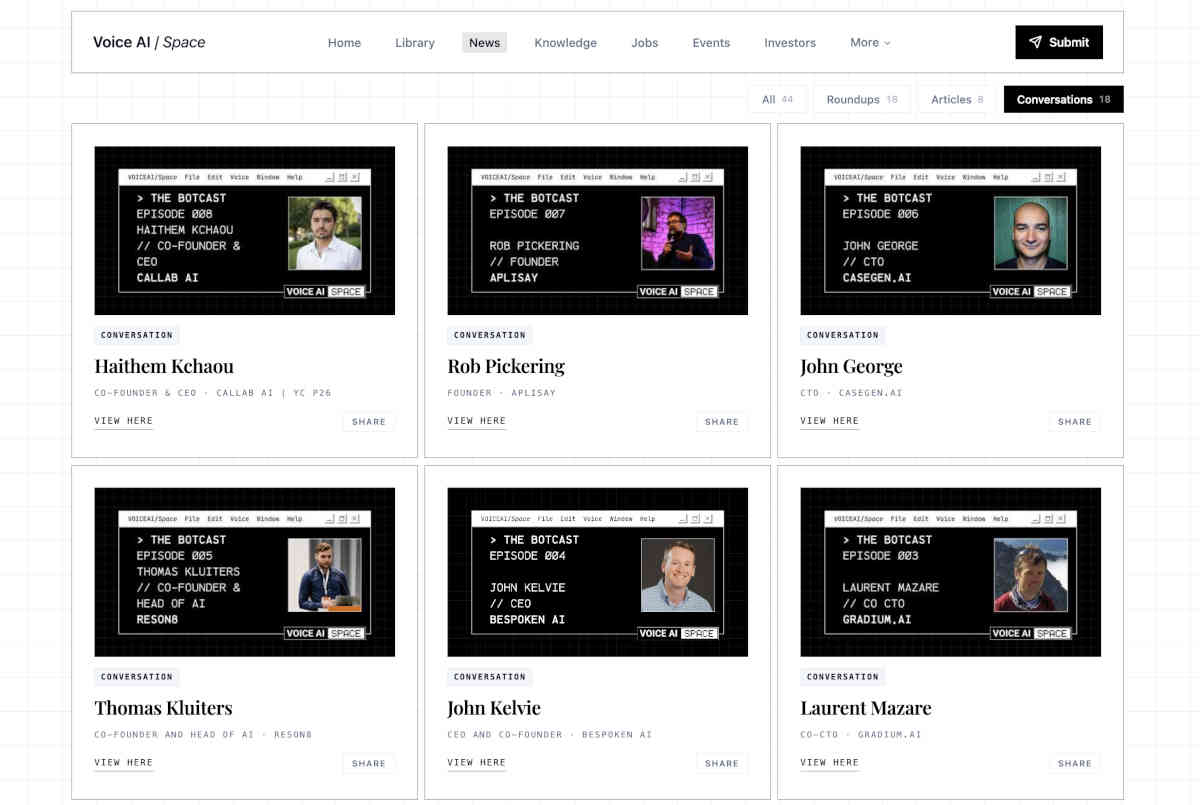 | |
| | | Twilio's AI Startup Searchlight Program is open |
In case you missed it, Twilio's AI Startup Searchlight Program is open for applications, and they're specifically looking for founders building in Voice AI, conversational AI and LLM-powered agents on the Twilio platform. Application Deadline: Friday, September 25th, 2026. | |
| | | Help us shape your content |
Got a minute? We'd love to know what you think of the newsletter so far, and what you'd like to see more of. 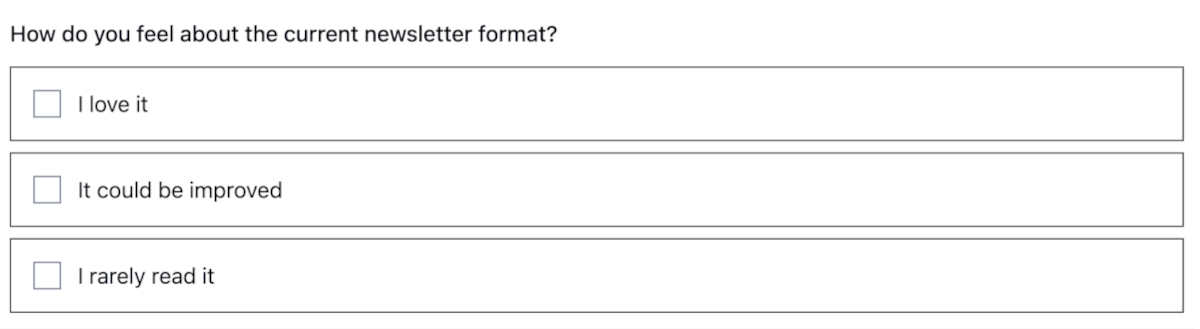 | |
|