| | Episode #9 The VoiceAISpace Newsletter | |
| | | 3 × News
2 × Products
1 × Spotlight
Space Updates | |
|
|---|
| | Flash Info Soniox launches TTS v2 One model for narration, creative
work and voice agents in 60+ languages |
| |
03 | News The Good, The Bad & The Funky |
| | Queensland startup Laronix is using AI to recreate a patient's own natural voice after disease or cancer removes the ability to speak, including after laryngectomy. The MIRA-AI approach works from as little as 10 seconds of prior audio (home recordings or even social media), instead of handing someone a generic synthetic voice. Founder Dr Farzaneh Ahmadi frames it as giving people the voice their family already knew. The company is in pre-release testing with clinicians in Australia and major US hospitals, with a broader release planned next year.
Why we like it:
This is the work we back. Same cloning stack the industry sells for ads and agents, pointed at recovery. When the loudest voice AI headlines are fraud and spam, a team rebuilding speech for throat-cancer patients is worth leading with.
| |
| | Fraudsters are cloning voices from clips as short as three seconds, then calling older adults while sounding like a child or grandchild in crisis. In central Pennsylvania, York County police warned that scammers are also using AI voice cloning to impersonate real sheriff's deputies, demand payment for fake warrants, and push Bitcoin, gift cards, or app transfers. On Jul 30, the bipartisan Senate Special Committee on Aging held a hearing on AI-enabled fraud against older Americans, with chair Sen. Rick Scott calling out voice cloning of loved ones as a growing line of attack.
Why it's bad:
This is the fraud playbook we stand against. Outbound calling is a product we defend when it is honest. Weaponizing three seconds of public audio against seniors is the opposite of consent, and it is already in the wild.
| |
| | Avi Schiffmann's screenless AI companion pendant relaunched on Jul 30 as Friend 2.0: a built-in speaker, a fixed (or randomly assigned) personality that talks back out loud, and a $249 hardware price. Conversation memory lasts 30 days unless you pay about $10 a month to keep it longer. It still pitches itself as a confidant against loneliness, not an assistant.
Why it's funky:
A necklace that argues with you about your ex and then charges rent to remember the fight is exactly the out-of-the-box swing we feature.
| |
Products Voice AI putting in the work | 02 |
| |  | #1 |
AI Group Call puts you on a live voice call with six AI participants, each cast around the goal you type in. The room includes a host, a skeptic, a strategist, and others assembled in seconds. They speak one at a time, argue with each other, and build on your ideas. The moment you open your mouth, whoever is speaking yields the floor. The feature set is built around real call behavior. You can interrupt mid-sentence, tap any avatar to rewrite their role or personality even while the call is running, pause to freeze your minute count, and rejoin the same cast later for a follow-up. Every call saves a full transcript, a one-tap summary, and a list of action items.
It is available now on Android, with iOS coming soon. New accounts get one free minute, no card required. Why we like it: this is a practical tool for anyone who thinks better out loud. Pressure-testing a pitch, rehearsing a negotiation, or stress-testing a launch plan all benefit from a room that pushes back, and AI Group Call delivers that without scheduling anyone. It is available now on Android, with iOS coming soon. New accounts get one free minute, no card required. | |
| | |  | #2 |
Fablr is a voice-first biography service that interviews your parent or grandparent by voice, then turns what they say into polished written chapters and a printed hardcover book. The whole thing costs $149 one-time (no subscription, no auto-renewal), includes a large-format hardcover shipped free in the US, and comes with a 30-day money-back guarantee. One button, no typing, no app to install. The voice AI here is doing real work. Conversations adapt to each answer the way a good interview should, and Fablr remembers what was said last week, not just five minutes ago. Snap a photo of an old ring or a recipe card and the AI asks follow-up questions until the object becomes a chapter. Every story in the printed book gets a small scannable code so readers can point a phone at the page and hear the storyteller's actual voice, no app required. Why we like it: this is voice AI solving a genuinely human problem in a way that feels obvious in hindsight. The product is built around the reality that most people will talk for an hour but won't write a sentence. The founder built it for his own dad, the company has no outside investors, and the privacy stance (no data sold, nothing used to train models) is baked into the product pitch rather than buried in a footer. That combination of clear use case, real voice interaction, and a physical artifact you can hold is a refreshing contrast to yet another chatbot wrapper. | |
|
|---|
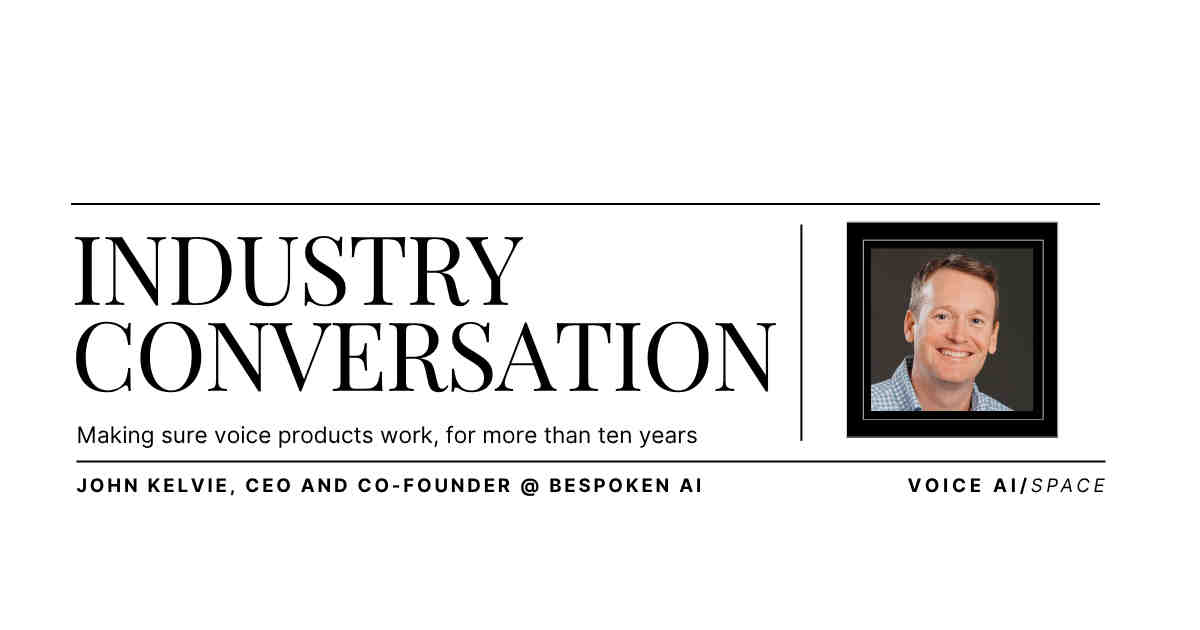
01 | Spotlight John Kelvie, CEO and co-founder @ Bespoken AI Founder conversation |
 |
| | Who are you, and what are you building?
I'm John Kelvie, CEO and co-founder of Bespoken AI. We help people build better voice experiences. For about 10 years we have provided testing, evaluation, and monitoring tools for voice AI and other AI systems, and by my count we have helped more than a hundred customers deliver exceptional voice experiences.
How did you end up in voice AI?
I started out working on speech recognition systems almost fifteen years ago, and I co-founded a startup in that space as CTO. Then I got interested in Alexa, Google Assistant, and the Amazon Echo when it came out. I thought these products were going to bring huge numbers of people into the ecosystem, that we would see millions of apps. So I built a company to help people test those systems and make sure they work well. We moved into IVR when Alexa and Google Assistant did not take off the way we expected, and now we have come to voice AI.
Your moment of joy and pain building with voice technology?
The joy is seeing our customers succeed. This technology is remarkable, and I have thought so for a long time. Watching customers do things they did not think were possible a year or five years ago is a real pleasure. The pain is how fast the market moves now. It is not only voice AI, it is everything in technology today. Keeping up is exciting, but it is also dizzying.
What lesson would you share with other builders?
Voice is tricky. A lot of people come into it from chatbots and assume it is straightforward, but nothing about voice is easy. You have to handle accents, languages, pauses, and disfluencies, and people who ramble. Beyond the technical challenges, people often reach for voice when other channels fail, because they are not available, or the app or website hit a wall, or they are driving. Those are harder scenarios. So my advice is to not underestimate the technology, and to deliver something beyond what people already get from a typical website.
Where do you see the voice AI industry in the next 12 months and the next five years?
In the next twelve months, I expect major adoption from Fortune 500 enterprises. There is adoption already, but real production deployments are happening now, and once that momentum builds I think it cascades across the enterprise and turns voice AI from something prospective into something real that drives value. That surprises me a little, I did not assume it would happen this fast.
In the next five years, here is my big prediction, and I am not the only one making it: enterprises get reconceived as agents plus databases. A voice bot that just does what your website or app already does is not enough. People need to re-architect, give agents more access, and let them solve problems they could not solve before. There is a lot of trust that still needs to build, but I think a lot happens in five years. Last thing: I am personally looking forward to the next version of Siri. I love Siri. I know people dog on it, but I think it has been good for a while, and I think it is going to be great. This interview was edited from the BotCast episode 4 soon on air ! | |
| | | The GLOBAL VOICE AI EVENT |
In a few days, in San Francisco, Bengaluru, London, Paris, Barcelona, Dubai, Toronto, Melbourne, and Istanbul, we’ll be gathering small groups of Voice AI people. It takes tons of work to organize, but with the support awesome people 🖤, we’re making it a reality… So... MAXI BIG UP to Loris Zammaretti, Evelyn Tan, Sam Adekunle, Pranava C Hiremath, Priiansh Gupta, Chitrang Thakkar, Mohamed Hani ElMasry, Sriram Balakrishnan, Marie Cécile de Faucigny, Davy Martial, Anusha, Miguel Twahirwa and Dilan Kurt for making this happen !!! And of course BIG UP to our sponsors Livekit, Twilio and Speechmatics for supporting us. A worldwide Voice AI event. How coooooool is that! | |
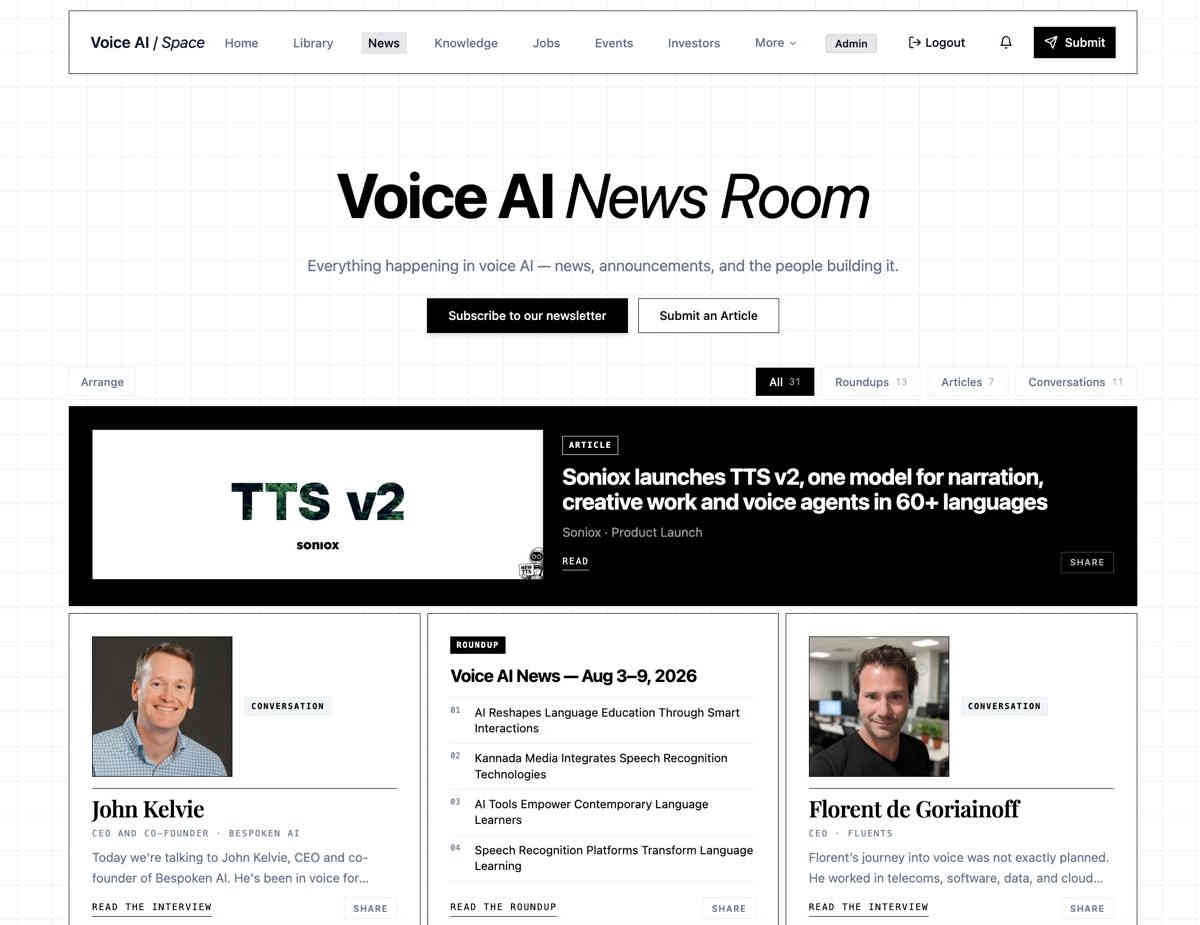
| | We spent some time scratching our head wondering how we could make the newsroom better, here is our copy... cards, with filters to allow you to see either all the content or only the one you're looking for. | |
| | Support & Share Enjoyed this newsletter? | |
| | Please share it with others interested in Voice AI, it helps us more than you think! If you have a Voice AI story yourself or a startup you are building that you wish to share, feel free to ping us.
Have a lovely morning, day, evening, or night wherever you might be.
The Voice AI Space team | |
|